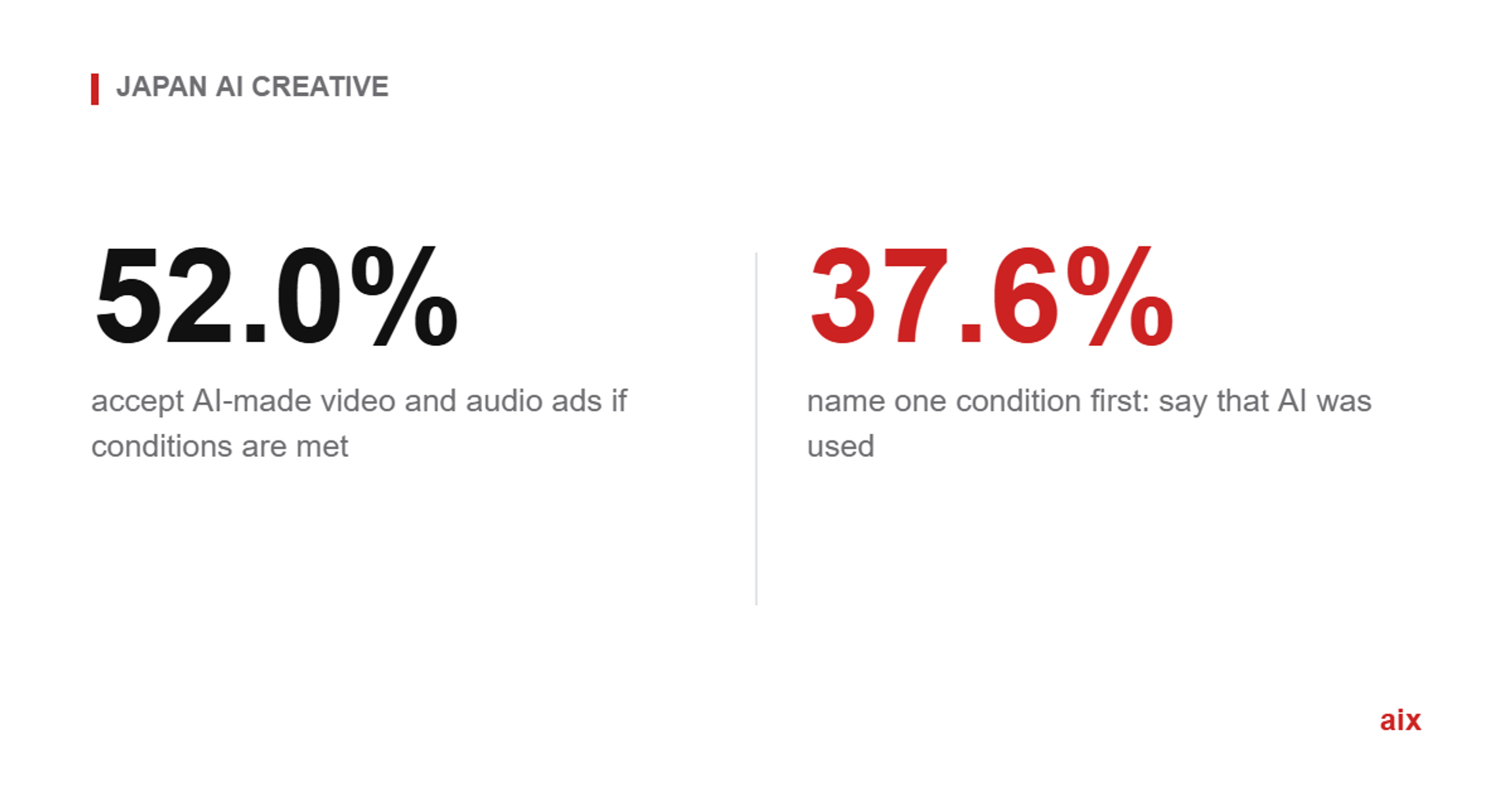
Are Japanese internet users rejecting ads made with generative AI? Most are setting conditions instead. In a 2026 survey by JIAA, Japan’s internet advertising industry association, 4.3% of respondents said generative AI should be actively used in advertising and 52.0% said it may be used if conditions are met, while 43.7% selected one of the two options opposing its use. Asked separately what would make such an ad acceptable, the most-chosen answer was that the use of generative AI be stated on the ad, at 37.6% (JIAA, 2026).
For a team running user acquisition in Japan, that moves the question from whether to use generative AI in creative to what has to be visible on the creative when you do.
What the survey actually asked
The scope is narrower than most coverage of this study suggests, and it changes what the numbers can be used for.
Every question quoted here was asked about ads that use generative AI in video or audio — the Japanese wording is 「映像や音声などに「生成AI」を活用した広告」. The survey did not ask about static banners, store screenshots or ad copy. Nothing here supports a conclusion about those formats.
The respondents are also a specific group. JIAA’s survey, conducted by Video Research, ran as a nationwide web survey from February 16 to 19, 2026, with 3,591 valid responses from men and women aged 15 to 69 who use the internet on a PC, tablet or smartphone almost every day, weighted to the composition of Japan’s resident register (JIAA, 2026). These are frequent internet users, not the general public.
One more reading note. The 43.7% figure is the combined total of the two options opposing use, not a single answer choice. It should be reported as a sum.
The three conditions users name
| Condition | Share choosing it |
|---|---|
| The use of generative AI is stated on the ad | 37.6% |
| Its use is regulated by law or guidelines | 30.4% |
| Permission for real people or characters used is clearly stated | 26.8% |
JIAA, 2026. Multiple responses permitted.
Two of the three are things an advertiser controls directly. Disclosure is a line of text and a decision in the creative review. Rights clearance for a likeness or a character is a step in production. The middle one — regulation — is not something a single advertiser supplies, and it is the only one of the three a team cannot act on this quarter.
This list and the 52.0% figure come from two separate questions in the same survey, and JIAA does not publish a base size for the conditions question. They are two independent findings from one study, not a breakdown of each other.
What the discomfort is actually about
Asked what impression such ads leave, 57.6% of responses fell into negative categories in total, and the single most-chosen impression was “it does not look real / it looks unnatural,” at 26.4% (JIAA, 2026). Both figures come from a multiple-response question; the 57.6% total and the 26.4% item are reported separately and one does not explain the other.
Taken at face value, the most common complaint is about execution quality rather than about the technology being used at all. An AI-made video that reads as unnatural is a creative problem with a familiar shape, and it is separate from the disclosure question, which is a process problem.
What to change in a Japan UA workflow
First, decide the disclosure rule before the first AI-assisted video goes into production, not at review. Disclosure is the most-named condition in the survey, and retrofitting it onto a finished cut usually means a re-export.
Second, keep the rule to video and audio. The survey asked about those formats. Extending a disclosure policy to static creative is a choice a team can make, but this evidence does not require it and does not measure it.
Third, treat likeness and character rights as a production step with a paper trail. 26.8% named explicit permission as a condition. Where a real person or a licensed character appears in an AI-assisted asset, the clearance needs to exist before the asset ships.
Fourth, judge the output on whether it reads as real. The most-cited negative impression was unnaturalness. A disclosure line does not fix a cut that looks wrong, and a good cut does not remove the need for the line.
What this survey does not say
It does not say Japanese users dislike AI-generated advertising as a category — 4.3% endorse active use and 52.0% accept it conditionally, which together describe a majority who are not opposed outright.
It does not measure advertising performance. These are stated attitudes, not click, install or completion behaviour, and this study does not connect the two.
It does not cover formats outside video and audio, and it does not describe the Japanese public — only those who are online almost every day.
Entering Japan? Rocket Ads by aix Inc. advises app publishers on user acquisition in the Japanese market, from creative localization to campaign structure.