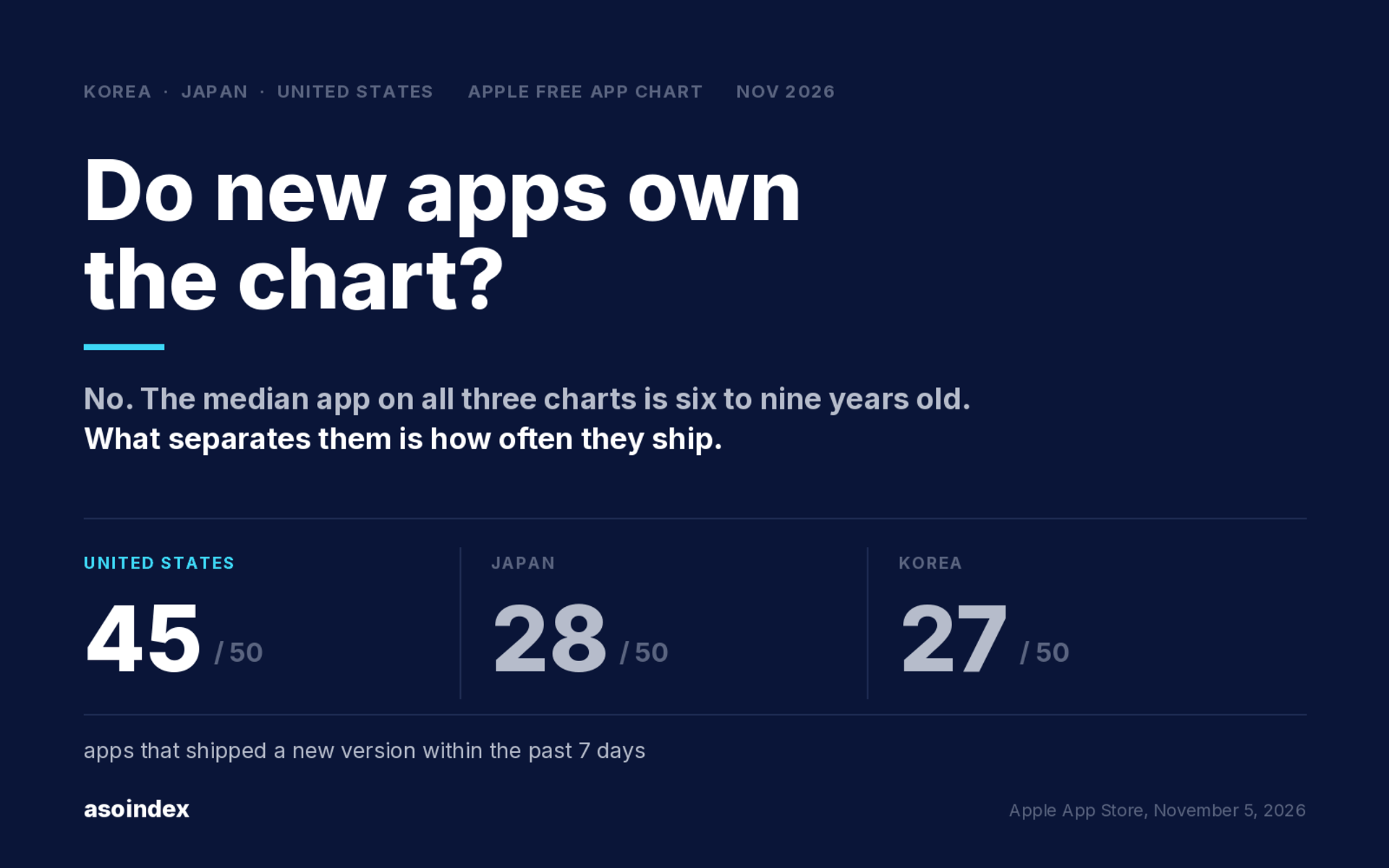
Is a spot at the top of the free chart something a new app wins? Not in these three markets. The median app in the Korean, Japanese and US iPhone free app charts was first released between six and nine years ago, and fewer than one in seven arrived this year (Apple App Store, November 5, 2026). The charts are held by incumbents. What separates the three countries is not how old the apps are but how often they ship: on the US chart 45 of 50 apps released a new version within the past week, against 27 of 50 in Korea and 28 of 50 in Japan.
Data: Apple App Store Top Free 50 for Korea, Japan and the United States, read from Apple’s public RSS feeds on November 5, 2026 (JP 09:48 UTC, KR 09:48 UTC, US 10:01 UTC), with each of the 150 apps then queried in its own storefront through the public iTunes Lookup API. Apple ranks apps and games on separate free charts; this is the apps chart, and it contains no games. “Age” is days since the app’s original App Store release; “shipped” is days since the current version’s release date. Paid and top-grossing charts are composed differently, and Google Play does not expose equivalent per-storefront listing data.
How old are the apps holding these charts?
| Japan | Korea | United States | |
|---|---|---|---|
| Median age | 2,232 days (6.1 yrs) | 2,254 days (6.2 yrs) | 3,326 days (9.1 yrs) |
| Five years or older | 29 / 50 | 28 / 50 | 32 / 50 |
| Released in 2026 | 4 / 50 | 7 / 50 | 3 / 50 |
Apple App Store Top Free 50, November 5, 2026.
Korea's chart is the most open to a recent arrival, and even there it is seven apps out of fifty. Four of those seven are finance or productivity apps from companies that were already established — a new app record rather than a new company. The genuinely new names are few: Pickle at #4 in Korea, released August 10, 2026, and Muse from Meta at #1 in Japan, released October 22, 2026 (Apple App Store, 2026).
This is the part worth sitting with. A team planning its first release often models the chart as the thing a launch buys. Measured across three markets on the same day, the chart looks more like a list of apps that have been there for years.
Then what is different between the three charts?
Release cadence, and the gap is not small.
| Japan | Korea | United States | |
|---|---|---|---|
| Median days since last version | 5.5 | 7.0 | 1.0 |
| Shipped within 7 days | 28 / 50 | 27 / 50 | 45 / 50 |
| Shipped within 14 days | 33 / 50 | 36 / 50 | 48 / 50 |
| More than 90 days | 2 / 50 | 1 / 50 | 0 / 50 |
Apple App Store Top Free 50, November 5, 2026.
On the US chart, the median app released a version yesterday. In Korea and Japan the median app released one a week ago, and roughly a third of each chart had not shipped in two weeks.
Is that just because the US chart holds more global apps?
That is the obvious objection, and it is worth testing rather than assuming. Apps built for many markets tend to run continuous release trains, and the US chart does hold more of them: 30 of its 50 support 20 or more languages, against 17 in Japan and 9 in Korea.
So compare like with like. Splitting each chart by supported-language count — a rough proxy for whether an app was built for one market or many — gives this:
| Chart | Group | Apps | Median days since last version | Shipped within 7 days |
|---|---|---|---|---|
| Japan | 20+ languages | 17 | 1.0 | 15 / 17 |
| Japan | 3 or fewer | 27 | 14.0 | 9 / 27 |
| Korea | 20+ languages | 9 | 1.0 | 9 / 9 |
| Korea | 3 or fewer | 32 | 8.0 | 14 / 32 |
| United States | 20+ languages | 30 | 1.5 | 27 / 30 |
| United States | 3 or fewer | 14 | 1.0 | 14 / 14 |
Apple App Store Top Free 50, November 5, 2026. Apps supporting 4 to 19 languages are not shown: 6 in Japan, 9 in Korea, 6 in the US.
The multi-language apps ship at the same pace on all three charts — a median of one to one and a half days, everywhere. The composition argument does not survive that row.
The difference sits entirely in the other group. Every one of the 14 single- or few-language apps on the US chart shipped a version within the past week. In Korea 14 of 32 did, and in Japan 9 of 27. A domestic app on the US free chart moves at the same speed as ChatGPT. A domestic app on Korea's or Japan's free chart, as a rule, does not.
What the dates do not tell you
Four limits, stated plainly, because they change what you can do with this.
A version release is not a listing change. The release date moves when a build ships. Screenshots, titles and descriptions can be rewritten without a build, and a build can ship without touching any of them. Read this as shipping cadence, not as how often these teams rewrite their store page.
Supported-language count is a proxy, not nationality. It separates apps built for one market from apps built for many. It does not tell you where the company is.
Frequency is not a ranking cause. This measures the apps that are already on each chart. It does not measure how often apps that never reached the chart ship, so nothing here shows that shipping more often lifts a rank.
This is one day and one chart type. November 5, 2026, iPhone free app charts. Some cells are small — the US domestic group is 14 apps — so these are counts and directions, not rates.
What to do with it
Set your cadence against your own market's chart, not a global benchmark. If you are a Korean or Japanese app, the competitive set you are actually listed beside ships every one to two weeks. That is the bar at home, and it is a different bar from the one on the US chart.
If you are planning a US listing, price the cadence in. The domestic apps there all shipped inside a week. Entering that chart with a quarterly release train puts you beside apps that touch the build daily.
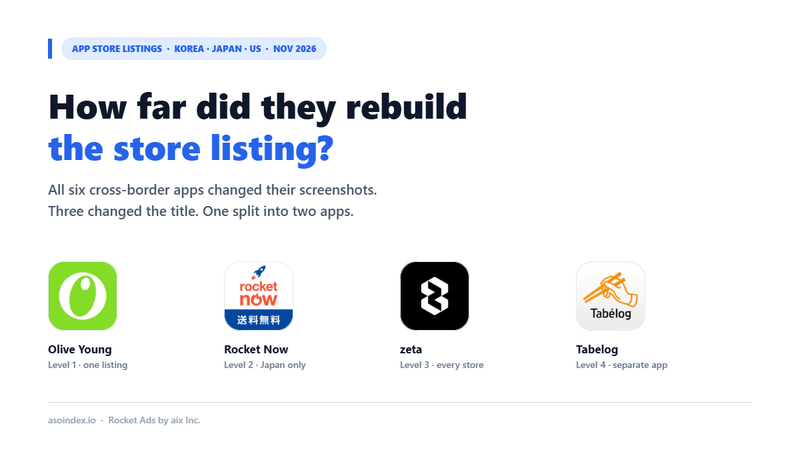
If you already ship weekly and you are entering Korea or Japan, cadence is not your lever. You are above the local norm before you start. What varies between apps in these markets is how far the listing itself was rebuilt for the country — a separate question, and one we measured last week.
Drop the assumption that launch week decides the chart. On all three charts, 28 to 32 of every 50 apps have been shipping for five years or more. Whatever put them there, it was not a launch.
Entering Japan or Korea? Rocket Ads by aix Inc. tracks the Korea and Japan app charts every week and helps app publishers acquire high-value users in Japan.