Did Korea just switch from Naver to Google? It depends which number you read. In July 2026, Google’s app passed Naver’s in monthly users for the first time. In the same year, Naver’s share of the search traffic arriving at Korean websites went up rather than down, and now sits more than two times above Google’s.
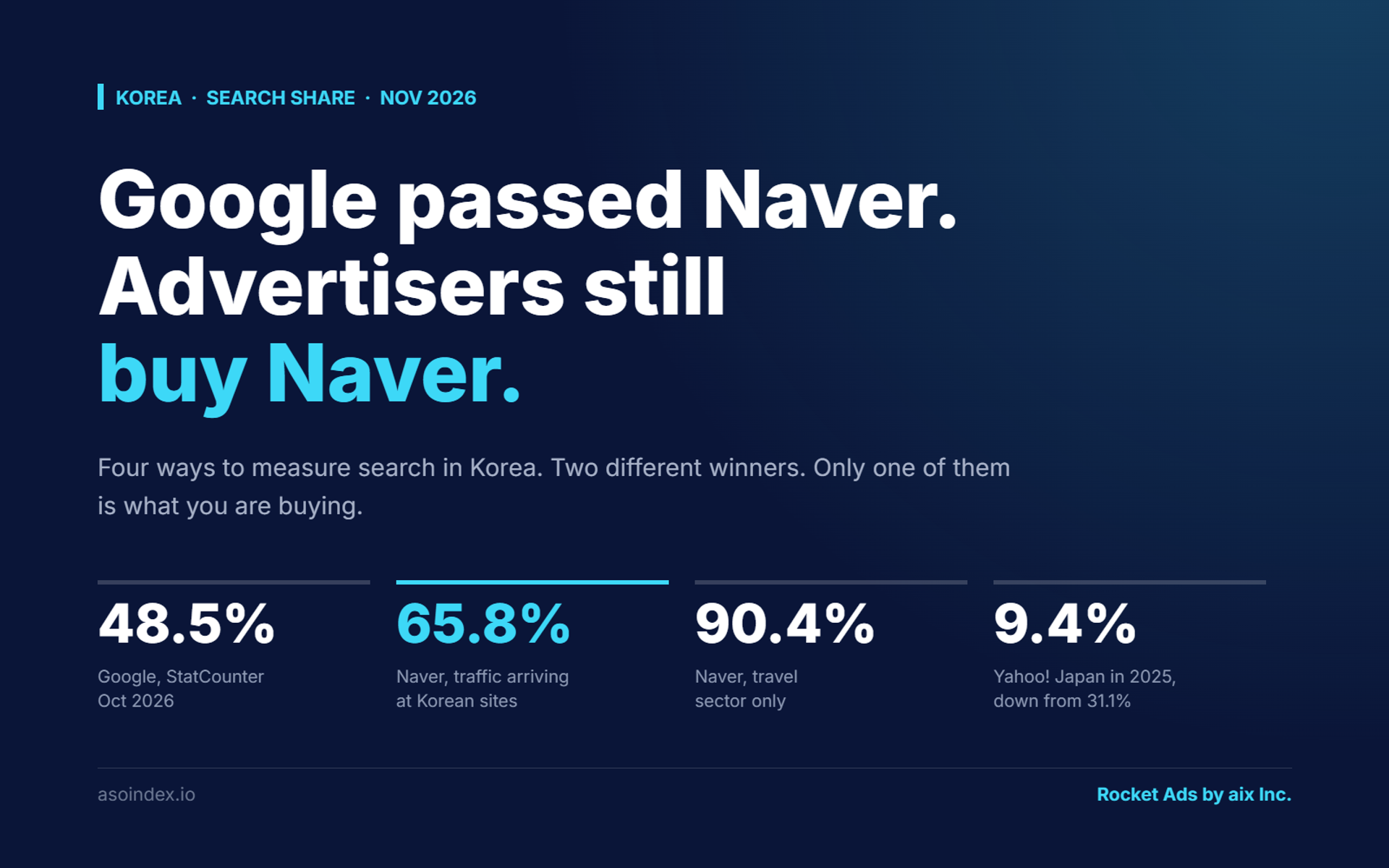
Japan went through this shift for real. Yahoo! Japan held 31.1% of Japanese search in 2016 and 9.4% in 2025, while Google went from 64.8% to 79.6% (StatCounter, read November 2026). Ten years, one direction, no reversal. Korea’s numbers do not line up that way, and the gap between them is the useful part.
What are the main search engines in Korea and Japan?
Korea runs on two: Naver and Google. Naver sent 65.8% of the search traffic that arrived at Korean websites in the 30 days to 10 November 2026, and Google sent 28.1% (InternetTrend). Bing at 3.0% and Daum at 2.4% are the only others above two percent. Japan runs on Google. Google held 79.6% of Japanese search in 2025 against Yahoo! Japan’s 9.4% and Bing’s 9.1% (StatCounter). The rest of this article is about why the Korean half of that answer is argued over, and which version of it an advertiser should use.
StatCounter counts traffic landing on sites that run its tracking code. InternetTrend counts visits recorded by loggers installed on Korean websites. WiseApp Retail estimates app usage from a smartphone panel.
Different samples give different answers. None of the three is wrong, and none of them can be added to another.
Is Google overtaking Naver in Korea?
App users. In July 2026, Google’s app reached 47.02 million monthly users against Naver’s 46.84 million, the first time it had been in front (inews24, August 2026).
Time in browser. In September 2026, Chrome led Korea’s search and browser apps on total time with 260 million hours, ahead of Naver’s 240 million. Chrome first passed Naver in May and has held the lead for five months (WiseApp Retail, October 2026).
Global tracker. StatCounter put Korea at 48.5% Google and 42.3% Naver in October 2026.
Read those three and the conclusion looks settled.
Does Naver still lead Korean search in 2026?
In the 30 days to 10 November 2026, 65.8% of the search traffic arriving at Korean websites came from Naver, against 28.1% from Google (InternetTrend). That is more than two to one.
The gap is also growing. In the first half of 2026 Naver sat at 64.39% and Google at 28.27%. Against the first half of 2024, Naver is up 6.54 percentage points and Google is down 4.69, which puts them 36.12 points apart (Hankyung, July 2026). Korean outlets link the move to Naver placing an AI tab at the top of its results. We checked the direction of the figures, not the cause.
Why do the two answers disagree?
Google leads inside the device. Which app opens, and how long it stays open. Chrome is the default browser on Android, so every page view adds to its total.
Naver leads on the way out. Someone searches, clicks a result, and lands on a company’s site. That second one is what an advertiser buys. A campaign is not paying for time spent in a browser. It is paying for the click that leaves the search page.
Which industries in Korea depend on Naver most?
The same source splits by sector, and Naver’s share moves a long way.
| Industry | Naver | Daum | Bing | |
|---|---|---|---|---|
| Community | 91.4% | 6.0% | 1.8% | 0.8% |
| Travel | 90.4% | 7.9% | 1.2% | 0.5% |
| Shopping | 72.8% | 15.4% | 6.6% | 3.1% |
| All industries | 65.8% | 28.1% | 2.4% | 3.0% |
Share of search traffic arriving at Korean websites. InternetTrend, 12 October to 10 November 2026.
In travel, nine in ten visitors arrive through Naver. That is 24.6 points above the all-industry figure. For a company selling flights or hotels in Korea, Naver is not one channel among several. It is close to the whole corridor.
Shopping sits at 72.8%, also above average, and that figure leaves out every journey that ends inside Naver itself. Someone who browses Naver Shopping and pays there never becomes an arrival at an external site, so Naver’s real weight in commerce is larger than this table shows.
What is the main search engine in Japan?
Japan handed search to Google, but Yahoo! Japan did not disappear. Nielsen Digital’s 2025 ranking puts Google at 84.76 million average monthly users against Yahoo! Japan’s 82.95 million. On average monthly GRP, the order flips: Yahoo! Japan 34,859 against Google 32,252 (Nielsen Digital, Tops of 2025: Digital in Japan).
More people use Google. Yahoo! Japan is in front of more of them, more often. Which one leads depends on the question, and that is not unique to Korea.
What do these numbers not tell you?
Why Naver’s share rose. The AI tab explanation comes from Korean press coverage, not from a study we could open. The figures moved in that direction; the reason is not established here.
How paid search splits. In the same dataset, traffic classified as CPC leans to Google Ads. Naver PowerLink clicks can land in the general Naver bucket rather than the paid one, so Naver’s paid share is likely understated. This is a classification problem, so we are not putting a number on it.
Whose industry classification this is. The sectors are InternetTrend’s own, built from the sites that run its logger. Sample sizes per sector are not published, and the gaming sector had no data in this window.
How long a window this is. Thirty days, from 12 October to 10 November 2026. The half-year comparison was calculated by Korean outlets from the same source.
What should advertisers do about it?
Ask which number. When a deck says “search share in Korea”, app users, time in app and site arrivals name different winners. This is where budget conversations go wrong.
If the job is sending people to your site, read arrivals. On that measure Naver leads by more than two to one, and by more than it did two years ago.
Check your sector before you split the budget. All industries is 65.8%. Travel is 90.4%. Those two numbers do not support the same plan.
Count what ends inside Naver separately. Journeys that never leave Naver Shopping are missing from arrival statistics. Reading arrivals alone will undercount Naver.
Rocket Ads by aix Inc. tracks the Korean and Japanese app markets every week. If you are planning user acquisition in Japan or Korea, we can go through which measure matches what you are actually buying.