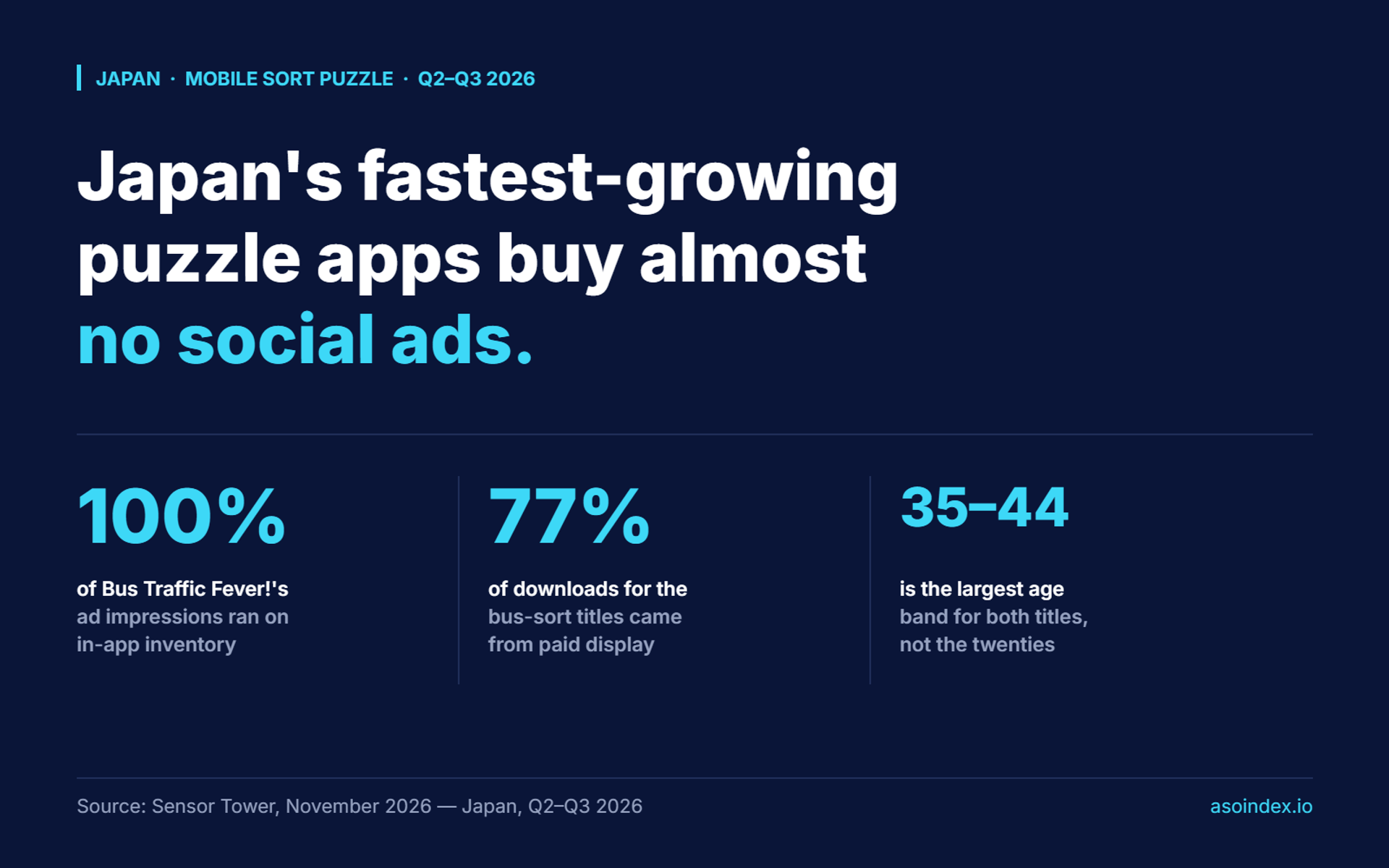
Where do Japan’s fastest-growing casual puzzle apps buy their installs? Almost entirely inside other mobile apps. In its November 2026 analysis of Japan’s mobile sort-puzzle category, Sensor Tower reports that paid display accounts for 77% of downloads for the two fastest-growing bus-sort titles, and that the share of their ad impressions running on in-app inventory is close to 90% for one and 100% for the other. The same data puts the largest age band for both titles at 35 to 44 — not the twenties.
That is two assumptions overturned at once for anyone planning a casual launch in Japan: that casual puzzle is a social-channel category, and that it is a young one.
What changed between Q2 and Q3 2026?
The leading sub-genre turned over in a single quarter.
In Q2 2026, the top two titles by download growth in Japan’s mobile sort-puzzle category were arrow-sort games — Amaze GO! from Oakever Games and Arrows – Puzzle Escape from Lessmore, both built around clearing arrows off the screen (Sensor Tower, 2026). In Q3 2026, two of the top three were bus-sort titles instead: Bus Traffic Fever! from GOODROID and Bus Fever Party from Lumi Games, both built around untangling a parking-lot jam.
Bus Traffic Fever! was the only Japan-origin title in that Q3 top three, and recorded download growth of more than 1.4 million (Sensor Tower, 2026).
Where do the installs actually come from?
Paid display, by a wide margin.
Looking at channel share of downloads across Q2 and Q3 2026 in Japan, paid display was the top channel for all four titles, and for the bus-sort titles that share reached 77% (Sensor Tower, 2026). These are not titles that found an audience organically and then advertised on top of it. The advertising is the distribution.
Which channels carry those impressions?
This is the part that contradicts the usual plan.
Using Pathmatics data for Q2 through Q3 2026 in Japan, Sensor Tower describes the arrow-sort titles as having mobile app as their top channel while also using Facebook and Instagram. The bus-sort titles do not split that way: Bus Fever Party runs close to 90% of its ad impressions on mobile app inventory, and Bus Traffic Fever! runs 100% (Sensor Tower, 2026). Sensor Tower frames the category-level move as in-app inventory going from around 80% to 100% of impressions.
| Title | Publisher | Sub-genre | Share of ad impressions on in-app inventory |
|---|---|---|---|
| Amaze GO! | Oakever Games | Arrow sort | Top channel, with Facebook and Instagram also used |
| Arrows – Puzzle Escape | Lessmore | Arrow sort | Top channel, with Facebook and Instagram also used |
| Bus Fever Party | Lumi Games | Bus sort | Close to 90% |
| Bus Traffic Fever! | GOODROID | Bus sort | 100% |
Sensor Tower, Pathmatics data, Japan, Q2–Q3 2026.
Who is actually playing these games?
Not the audience most media plans assume.
Sensor Tower’s Audience Insights data for Q2 through Q3 2026 in Japan puts the largest age band at 35 to 44 for both bus-sort titles. The second-largest band differs: 25 to 34 for Bus Traffic Fever!, and 45 to 54 for Bus Fever Party. More than 10% of Bus Fever Party users are 55 or older (Sensor Tower, 2026).
The gender split differs too. Bus Traffic Fever! is roughly 50% men and 50% women, while Bus Fever Party is 36% men and 64% women (Sensor Tower, 2026). Two titles in the same sub-genre, acquired through the same channel mix, reaching measurably different people.
| Bus Traffic Fever! | Bus Fever Party | |
|---|---|---|
| Largest age band | 35–44 | 35–44 |
| Second-largest band | 25–34 | 45–54 |
| Gender split | 50% men / 50% women | 36% men / 64% women |
| Users aged 55+ | Not reported | More than 10% |
Sensor Tower, Audience Insights data, Japan, Q2–Q3 2026.
What changed in how these games make money?
The arrow-sort titles at the top of the download-growth ranking monetise through advertising and ad removal. Bus Traffic Fever! adds in-game currency bundles and starter packs on top of those, and placed in the top three for revenue growth in Japan’s sort-puzzle category in both Q2 and Q3 2026 (Sensor Tower, 2026).
That comparison needs one caveat stated plainly, and it sits in Sensor Tower’s own methodology note: its revenue figures are in-app purchase estimates from the App Store and Google Play, and exclude advertising revenue. A title that monetises mainly through ads will therefore look weaker on revenue growth by construction. The honest reading is that adding in-app purchases gave Bus Traffic Fever! a revenue line this dataset can see, not that ad-monetised titles earn less.
What should change in a Japan casual launch plan?
Four things, each inside a user acquisition team’s own authority.
Budget the in-app network as the primary channel, not the overflow. The two fastest-growing titles in this category put 90% to 100% of their impressions there. A plan that treats Meta as the default and in-app as a test allocation is inverted relative to what is currently working in this category in Japan.
Build creative for in-app placements first. Interstitial and rewarded placements inside other apps are a different unit than a social feed. If the first cut is made for the feed and then resized, the primary channel gets the worst version of the asset. What Japanese users expect from the creative itself is a separate question, and it has its own answers.
Move the target age band up. The top band here is 35 to 44, with a meaningful tail past 55 on one title. Age targeting set to 18–34 out of habit excludes the largest group of actual players.
Do not assume one audience per sub-genre. These two titles sit in the same sub-genre and use the same channel, and one is 64% women while the other is an even split. Audience composition is a per-title measurement, not a genre default.
What this data does not show
Four titles across two quarters. These are download-growth and revenue-growth rankings from one Japanese sub-genre in Q2 and Q3 2026, not a measure of absolute size. Read it as a count, not a rate.
Channel share is not performance. Knowing where these titles bought impressions does not establish what those impressions returned. Nothing here reports cost per install, retention or return on ad spend.