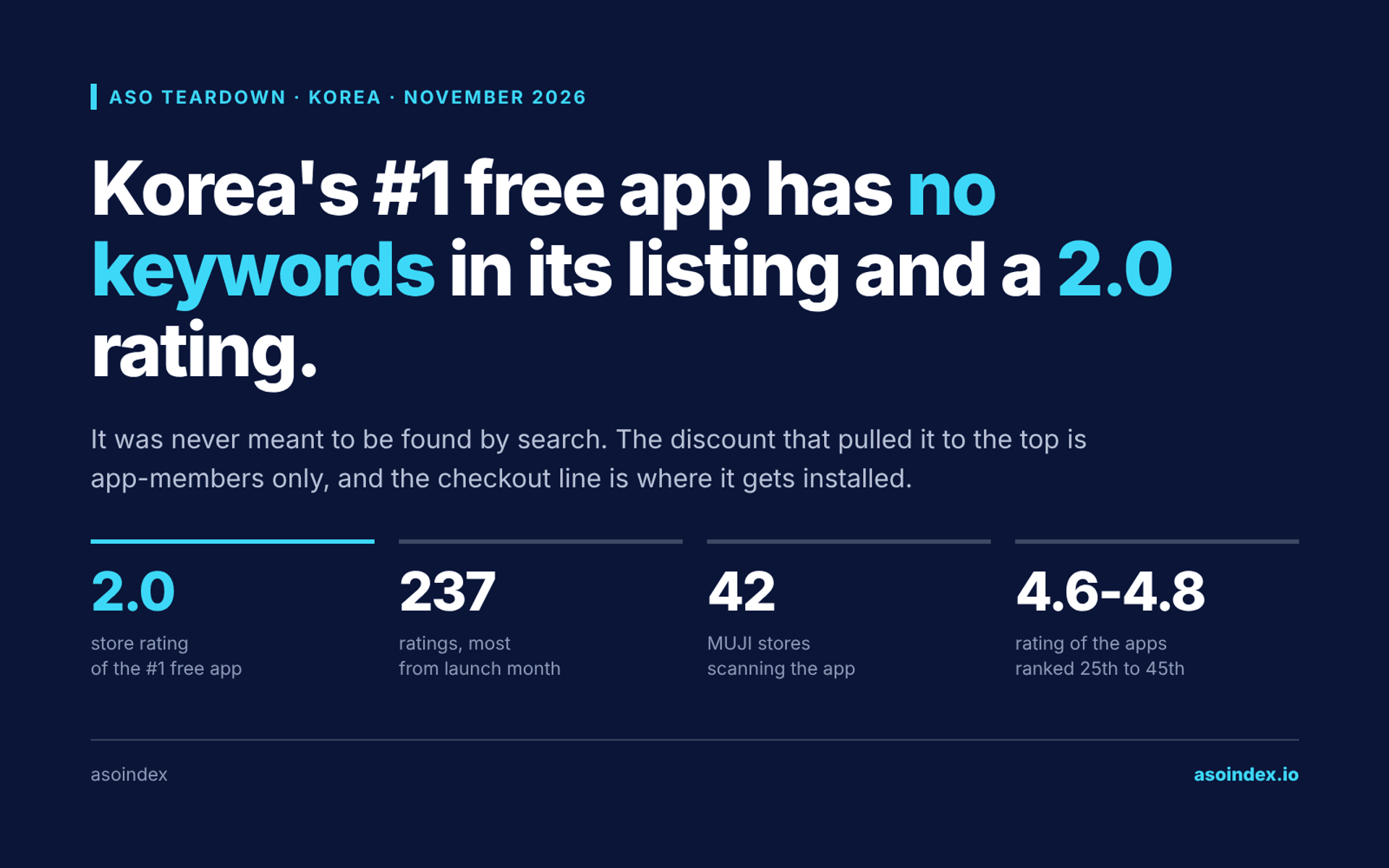
Filling the store title and subtitle with keywords is treated as the baseline ASO task. Most of the apps that entered Korea’s App Store Top 50 this week do exactly that. The app that reached #1 does the opposite. Its title is a seven-character brand name, its subtitle is a slogan rather than a keyword string, and its rating is 2.0 out of 5.
It is not an app that skipped its ASO homework and won anyway. It is an app that never needed to be found by search.
Data. Korea’s Apple App Store Top Free 50, 16 November 2026, compared with the week before. Titles, subtitles, ratings and rating counts were read from each app’s Korean App Store page the same day.
What this week’s new entries put in their listings
| App | Rank | Title | Subtitle | Rating | Ratings |
|---|---|---|---|---|---|
| MUJI KR | 1 | MUJI KR | 기분 좋은 생활의 시작 - 무인양품 (“The start of a pleasant life - MUJI”) | 2.0 | 237 |
| AnySchedule | 25 | AnySchedule - 공유 캘린더·일정 관리 플래너 | 잠금화면 위젯·할일·투두·습관 트래커 | 4.6 | 2,800 |
| Uniple | 36 | 유니플 Uniple: 둘이 직접 만드는 커플앱 | 데이트 지도·캘린더·디데이·가계부·다이어리 | 4.6 | 19 |
| 101cam | 45 | 101cam - 필름 & 디지털 카메라 | Analog for the Digital Age | 4.8 | 782 |
Korean App Store, 16 November 2026. Four of the nine apps that entered Korea’s Top 50 this week.
The lower three follow the textbook. They put the function in the title and then list keywords in the subtitle, separated by interpuncts. Uniple fits five into one subtitle line. All three are rated 4.6 or higher.
MUJI KR is the exception on every column. Its title is the brand and the market, nothing else. Its subtitle is a brand line. The only searchable word in the whole listing is the brand name itself. Its 2.0 is the lowest rating in the table, and it is #1.
So how did it get to number one?
It was outside the Top 50 on 9 November. It was #1 on 16 November.
MUJI WEEK opened on 13 November. According to MUJI Korea’s event page, the sale runs 13 to 23 November with 10% off everything, and the stated condition is MUJI APP membership.
The page also sets out how the discount is claimed. Online, it applies automatically once you sign in. In a store, the member barcode has to be scanned before payment, and the page states that the discount cannot be applied retroactively once the transaction is done. It advises signing up before the sale begins.
MUJI Korea operates 42 directly managed stores. For eleven days, each of those checkout counters is a place where the app has to already be installed for the customer to save 10%.
This app appears to be installed at a till rather than chosen from a search result. We did not see install figures, so we are not stating it as proven. What is established is that the discount requires the app, that the sale opened on 13 November, and that the chart position moved from outside 50 to 1 in that window.
The 2.0 rating came out of the same mechanic
A 2.0 rating on a #1 app looks like an error until you open the reviews.
Of the 237 ratings, the reviews surfaced on the listing were written between February and June 2025. MUJI KR arrived on Korea’s App Store on 17 February 2025, so these are from its first months. They are not complaints about features. They are complaints about a migration: points from the previous MUJI Passport membership not carrying over, accounts that could not be recovered, staff giving different instructions in different stores.
The structure is the same one running now. Move the membership benefit inside an app and the existing members have to install it. The ones who hit friction on the way in leave a rating at that moment.
So the 2.0 reads less like a current quality score and more like a record of a transition that happened a year and nine months ago. That record is still sitting at the top of the listing today.
How big the brand behind it actually is
“It has a brand” is an empty explanation unless you can size it. In this case the numbers exist.
MUJI opened its first Korean store in 2003 inside Lotte Department Store’s main branch, and the joint venture MUJI Korea was established in 2004 with Ryohin Keikaku holding 60% and Lotte Sangsa 40%. Lotte Shopping took over the Lotte Sangsa stake at the end of 2022 (NewDaily, October 2025).
In the fiscal year running September 2023 to August 2024, revenue was 180.5 billion won, up 20% year on year and the highest since entering Korea. Operating profit rose from 1.8 billion won to 7.5 billion won, and the same year carried a net loss of 2.5 billion won (Herald Business, September 2025).
The path was not smooth. The company posted operating losses for four consecutive years from 2019, and was in full capital erosion in the 2022 fiscal year (Seoul Economic Daily, September 2025). In August 2025 Lotte Shopping joined a 20 billion won capital raise, and in October 2025 MUJI Korea reopened its Yongsan I’Park Mall branch at roughly 2,680 square metres.
That is more than twenty years of presence, one collapse, and a recovery. None of it is an asset ASO can manufacture. A store listing is persuasion aimed at someone who already arrived; MUJI solved the arriving part with 42 stores and two decades.
Does this mean ASO does not matter?
It means the opposite. The case shows what an app needs in order to not need ASO, and most apps do not have it.
Look at the same table again. The other three have close to no brand recognition. Uniple launched on 12 November and has 19 ratings. AnySchedule and 101cam have no physical footprint at all. For these apps the title and subtitle are the only place discovery can happen. They fill them with keywords not because a guide told them to, but because there is nothing else available to them.
One detail is worth sitting with. 101cam’s subtitle is “Analog for the Digital Age”, which contains no Korean at all. It is a Korean app, made by SNOW, ranking on the Korean chart, and it spends its subtitle on an English brand line. That may be deliberate positioning. But unless you are a brand people search by name, that line is expensive real estate.
What to take from it
Korea’s #1 free app this week has no keywords in its listing and a 2.0 rating. Both facts are true at once, and neither stopped it.
The sale that moved it is app-members only, and in stores the barcode must be scanned before payment. Across 42 stores, for eleven days.
The 2.0 was built during the 2025 membership migration and is still the first number on the listing. Ratings accumulate; chart positions reset weekly.
The apps without a brand all wrote keyword-packed subtitles and all rate 4.6 or better, and they placed 25th, 36th and 45th.
If you have the brand and the offline footprint, you can skip the listing and survive the rating. If you do not, those two things are the entire budget. Deciding which of the two you are comes before rewriting a subtitle.
asoindex looks at Korean and Japanese app store data every week.