Teams planning a Japan or Korea launch usually ask the question in one piece: are we ready to go live there? It is actually two questions. One is whether your service can operate in that market. The other is whether your listing should be in that storefront. The apps on the charts have already answered the second one, and most of them answered it on day one.
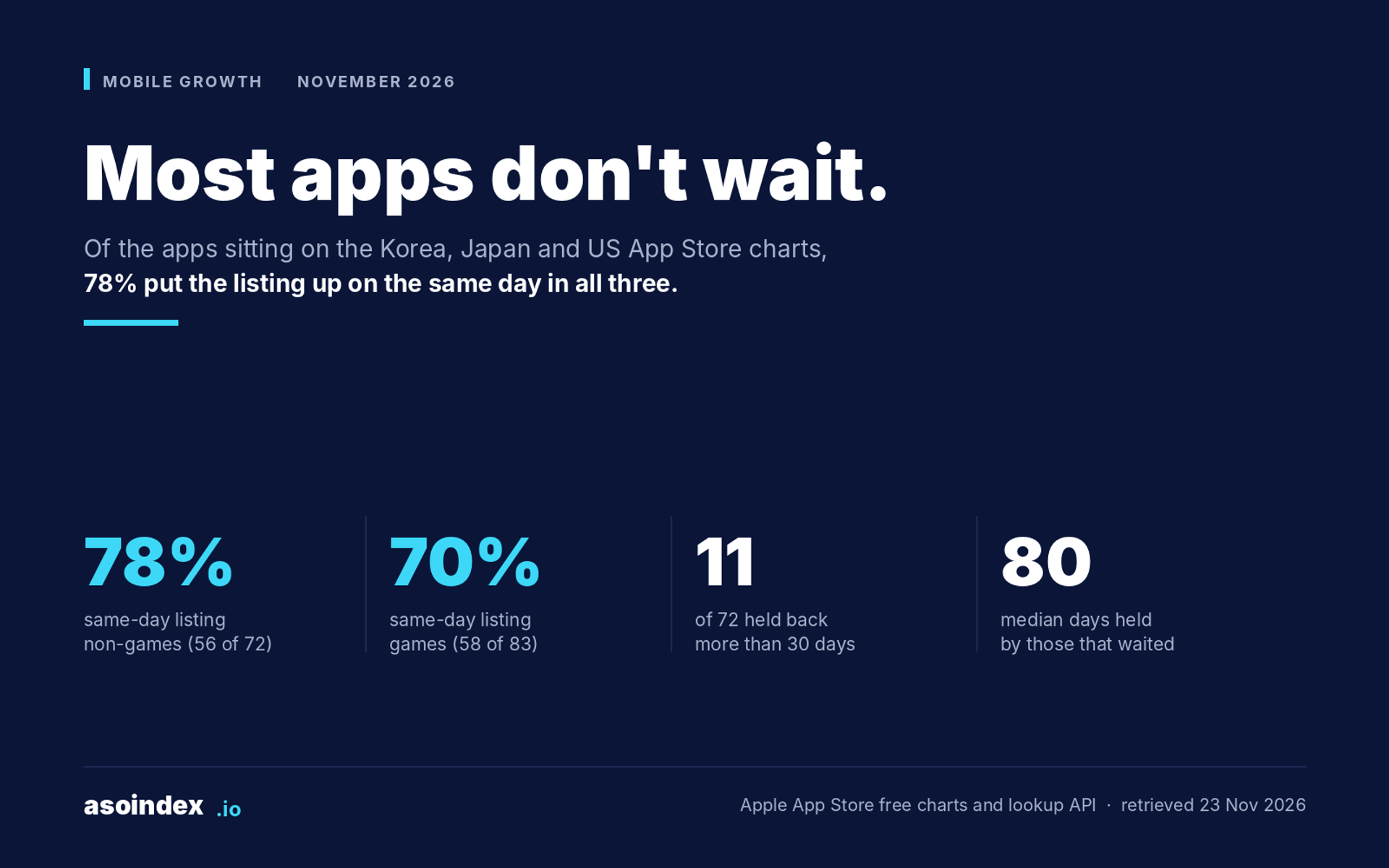
We took every app on the Korea, Japan and US free App Store charts, looked up its release date in each of the three storefronts, and compared them. Of the 72 apps that exist in all three, 56 went up on the same calendar day in all three (Apple, retrieved November 23, 2026).
What this number is, and what it is not
Apple publishes a release date per storefront. That date is when the listing became available in that country, not when the service launched there. The two can be the same and often are not, so this article is about the listing decision only.
The sample is the apps currently charting in all three countries, so it describes apps that reached all three, not apps in general.
Most apps go up everywhere on the same day
| Free charts, Nov 23, 2026 | Apps in all three storefronts | Same release date in all three | Share |
|---|---|---|---|
| Overall chart (no games in the overlap) | 72 | 56 | 78% |
| Games chart | 83 | 58 | 70% |
Apple App Store Top Free 50 (overall) and Top Free 50 (Games), Korea, Japan and the US. Release dates retrieved per storefront on November 23, 2026.
Two things in that table are worth sitting with.
The first is that same-day is the majority answer in both rows. The second is that games are not the same-day category. The usual framing says casual games open worldwide and non-game apps roll out market by market. In this data games stagger slightly more often, not less. The dividing line is somewhere else.
The apps that waited have something in common
Only 11 of the 72 held a listing back by more than 30 days. Here is what they are.
| Hold | App | US | Japan | Korea |
|---|---|---|---|---|
| 9 yr 7 mo | Spotify | 2011-07-14 | 2016-09-28 | 2021-02-01 |
| 5 yr 6 mo | Coupunch (Coupang) | 2024-03-06 | 2025-01-08 | 2019-07-01 |
| 5 yr 5 mo | GO (taxi hailing) | 2023-02-19 | 2017-09-12 | 2023-02-19 |
| 1 yr 11 mo | Shop (Shopify) | 2017-11-16 | 2019-10-08 | 2019-10-08 |
| 231 days | Burger King Japan | 2019-11-26 | 2019-04-09 | 2019-11-26 |
| 139 days | Rocket Now (Coupang) | 2025-06-01 | 2025-01-13 | 2025-06-01 |
| 131 days | MynaApp (Digital Agency) | 2020-02-28 | 2019-10-20 | 2020-02-28 |
| 93 days | PlayStation App | 2013-11-13 | 2014-02-14 | 2013-12-12 |
| 68 days | Roaming Dokkaebi eSIM | 2021-06-22 | 2021-07-12 | 2021-05-05 |
| 54 days | TeraBox | 2020-06-22 | 2020-04-29 | 2020-04-29 |
| 51 days | Google Home | 2013-08-27 | 2013-10-17 | 2013-10-17 |
Bold marks the storefront that got the listing first where it was not the US.
Read the top of that list and the pattern names itself. Music licensing. A taxi fleet. Merchant accounts. Restaurants. A delivery network. A national ID system. A mobile carrier. Every one of these apps needs something to already exist in the country before the app does anything at all.
Spotify is the clean case because we can check it against the company’s own announcement. Spotify’s newsroom dates the Korean launch to February 1, 2021. The Korean listing date in Apple’s data is February 1, 2021. The listing and the market opened on the same day because there was no reason to open one without the other.
Now read the 56 that went up everywhere at once: ChatGPT, Claude, Gemini, Threads, Google Maps, Duolingo, CapCut. Nothing has to exist in Korea for Claude to work in Korea.
The direction is not only US to Asia
Four of the eleven got their listing somewhere other than the US first.
GO, Japan’s taxi hailing app, was in the Japanese storefront five and a half years before the US and Korean ones. Burger King’s Japan app led by seven months, and Coupang’s Japanese delivery app Rocket Now by four and a half. Coupang’s workforce app Coupunch was in Korea in 2019 and did not reach Japan until 2025, a gap of five and a half years.
The “launch in the US, then expand to Asia” picture is a global software company’s picture. It is not what a local service does.
Games follow the same rule, not a different one
The largest gaps on the games chart are Fortnite at 364 days and Pokémon GO at 200 days. Both run live services with regional servers, ratings boards and partners. The puzzle and merge titles around them are overwhelmingly same-day.
So the question that predicts a staggered launch is not “is this a game.” It is “does anything have to be standing in that country before this works.”
So what should you decide?
Three numbers are worth carrying out of this.
78% and 70%. Among apps that make it onto all three charts, same-day listing is what the majority did, in both games and non-games. If your plan assumes a staged listing is the normal path, the charts disagree.
11 of 72. Only fifteen percent of these apps held a listing back by more than a month, and eight of those eleven were apps that needed a licence, a fleet, a store network, a delivery network, a carrier deal or a government system.
80 days. That is the median hold among the apps that did wait. Holding a listing is not a two-week decision. In this set it was most of a quarter, and four apps held for more than a year.
With those in hand, the decision reduces to one question about your own app.
Open your app in a country where you have nothing in place. Is there anything useful on the screen?
If there is, put the listing up early. The storefront starts indexing your title and keywords, the first reviews start accumulating against your name rather than against nothing, and when your operation is ready the listing is already there with history behind it instead of being born the week you need it to perform.
If there is not, holding is not a delay, it is a defence. An app that opens to an empty state in a market you cannot serve collects one thing reliably, and it is one-star reviews that outlive the launch. Spotify did not put a Korean listing up in 2016 and wait five years with it. It put the listing up the day it had something to play.
The mistake is treating these as one decision. Most of the apps on these charts do not.
Method
On November 23, 2026 we took the Korea, Japan and US free App Store charts (overall Top 50, and Top 50 within Games) and requested each app’s metadata from Apple’s lookup API once per storefront, using the matching country code. An app counts here when all three storefronts return a record for it; we compared the release date each storefront reports and measured the spread between the earliest and latest. Dates are as Apple reports them, in each storefront’s own calendar.
Sources
- Apple App Store free charts and lookup API, Korea, Japan and the United States, retrieved November 23, 2026
- Spotify Newsroom, “Spotify Launches in South Korea,” February 1, 2021
- asoindex, “Should You Bother With iPad Screenshots?”